Homestyle June 2026 — The Last word.
Waiheke Island textile designer Sophie Poelman on Lof’s new lighting works (original text)
Our design studio is right in the heart of the only industrial area on Waiheke Island, tucked in between a water delivery business and a car wreckers. It’s a pretty humble setting, but we love it. Sunlight pours into the space, which is apt seeing as we work with a warm, cosy material: we design and handcraft pendant lighting using New Zealand-grown strong wool. Lof is interested in how design can add value to the materials we grow well here in Aotearoa. Strong wool is abundant, local and possibly a bit scratchy on your neck in a hand-knitted jumper, and today, largely undervalued.
I began the journey that led to Lof six years ago, in 2020, and today my husband, industrial designer Alain Brideson, and I design the products together. My background is in textiles and soft materials, his is in automotive design and hard materials. That unlikely combination has allowed us to push what wool can do as a design material. The starting point for Lof was really a sense of unfairness. The local strong wool industry was in a dire state, with wool being stored, buried, even burnt, because it wasn’t worth enough to sell. Farmers were losing money every time they sheared their sheep, and there was a real hopelessness about it all. I kept coming back to the same thought: the most sustainable thing I could do as a designer was work with the materials we grow here and add value through design.
From there, the work became very material-led. We started exploring wool not just for how it looks, but for how it performs. We found it softens light, absorbs sound and brings a quiet warmth into a space. We knew we needed to design a wool product that supported the kind of sustainable business model we were after, and lighting just made perfect sense.
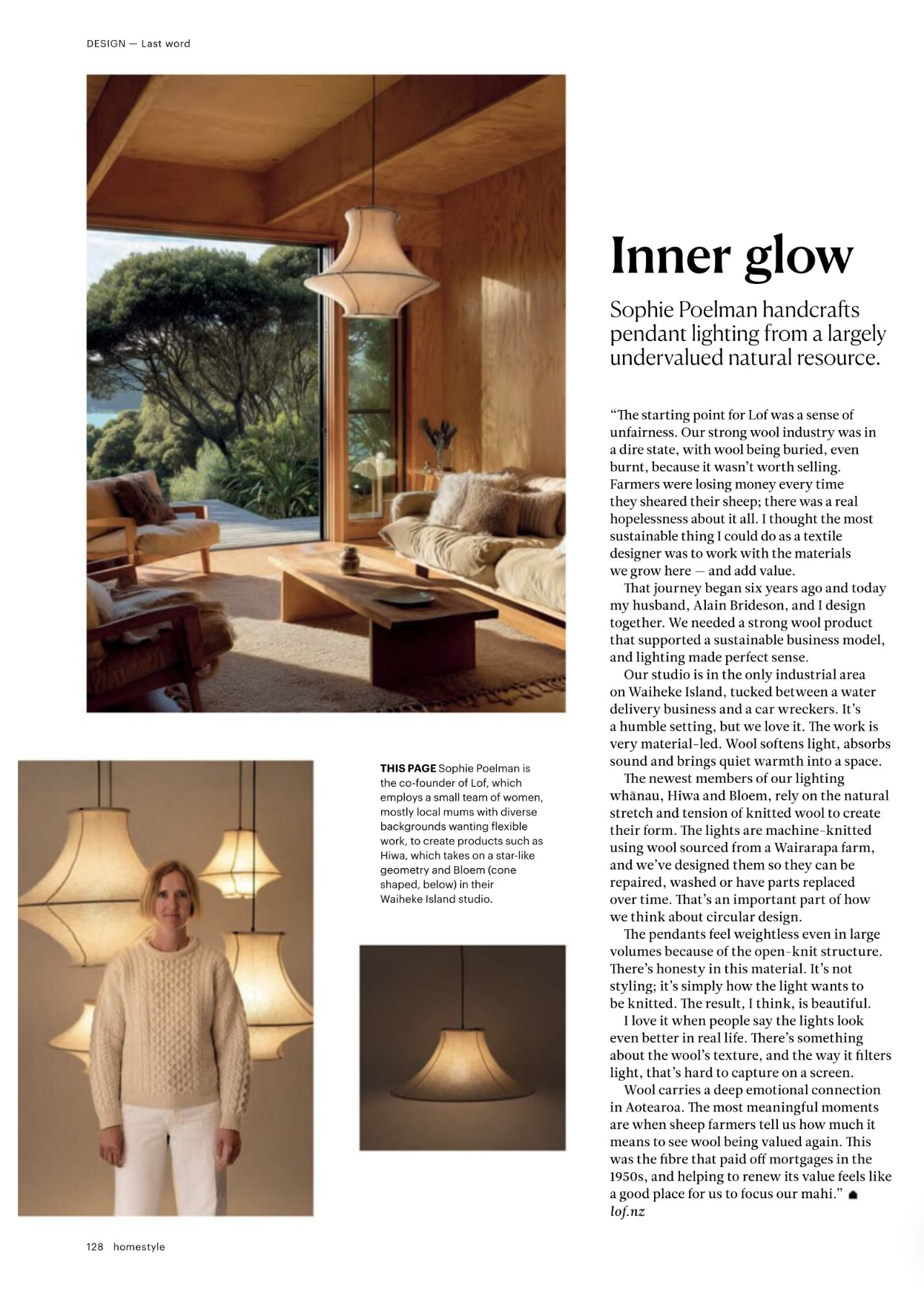
The newest members of our lighting whānau, HIWA and BLOEM, have grown out of that same exploration with wool. Both rely on the natural stretch and tension of knitted wool to create their form. HIWA takes on a star-like geometry, while BLOEM has a more open cone shape. There are small references to mid-century lighting, but the shapes are really driven by the behaviour of the knit itself. The lights are machine-knitted using wool we source directly from a farm in the Wairarapa, and we’ve designed them so they can be repaired, washed or have parts replaced over time. That’s an important part of how we think about circular design.
I like that the pendants feel light and weightless even in large volumes because of the open-knit structure. There is also an honesty in this material – the knit pattern follows the shaping needed to create the form. It’s not styling; it’s simply how the light wants to be knitted, and the result, I think, is beautiful. I love it when people say the lights look even better in real life. There’s something about the texture of the wool, and the way it filters light, that’s hard to capture on a screen.
For now, we’re focused on building both the product range and the business from our little Waiheke studio. We have a small team of exceptional women working with us, mostly local mums with diverse backgrounds wanting flexible work around their families, which feels like an important part of what we’re building too, here in our small island community.
Wool carries a deep emotional connection in New Zealand, and the most meaningful moments for me are when sheep farmers tell us how much it means to see wool being valued again. This was the fibre that paid off mortgages in the 1950s, and helping to create a renewed sense of value for it feels like a good place for us to focus our mahi.
Read the final article in Homestyle Magazine, June 2026.